Exercise 10 : Show Stars
This is a very popular exercise for junior programmers involving a function called showStars with a parameter called rows.
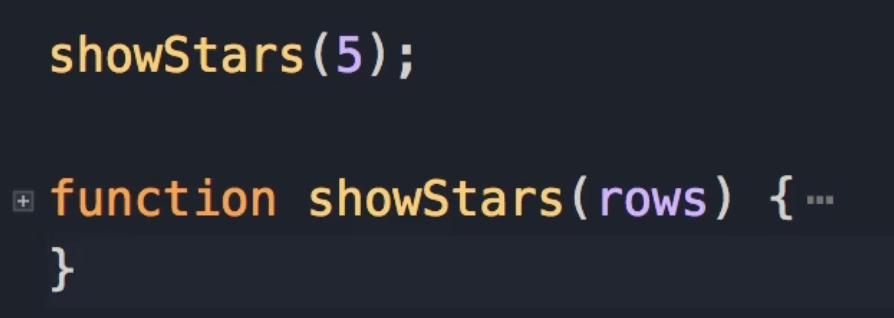
Exercise Description
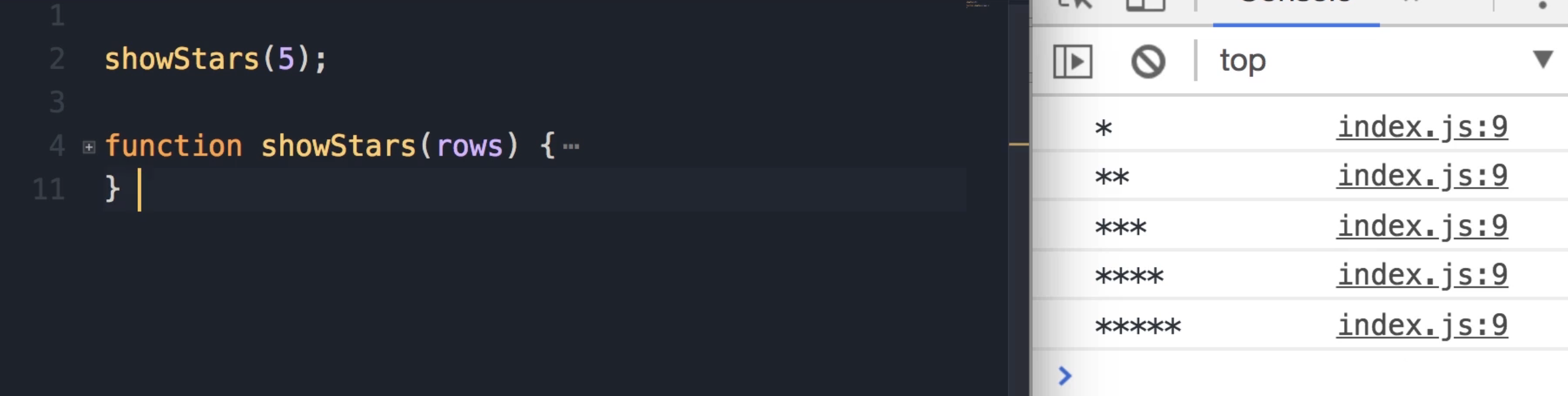
We want to create a function where the number of stars in a row depends on the row we are in. When we call this function and pass a number (e.g., 5), see what we get on the console:
-
We get 5 rows.
-
In the first row, we have one star.
-
In the second row, we have 2 stars, and so on.
-
If you call this function and pass 1, you get only a single star.
showStars(1) -
If we pass 2, we get 2 rows and 2 stars.
showStars(2)
Student Pause Point: "So go ahead and spend 5-10 minutes on this exercise, when you're done, come back and continue watching."
Solution:
-
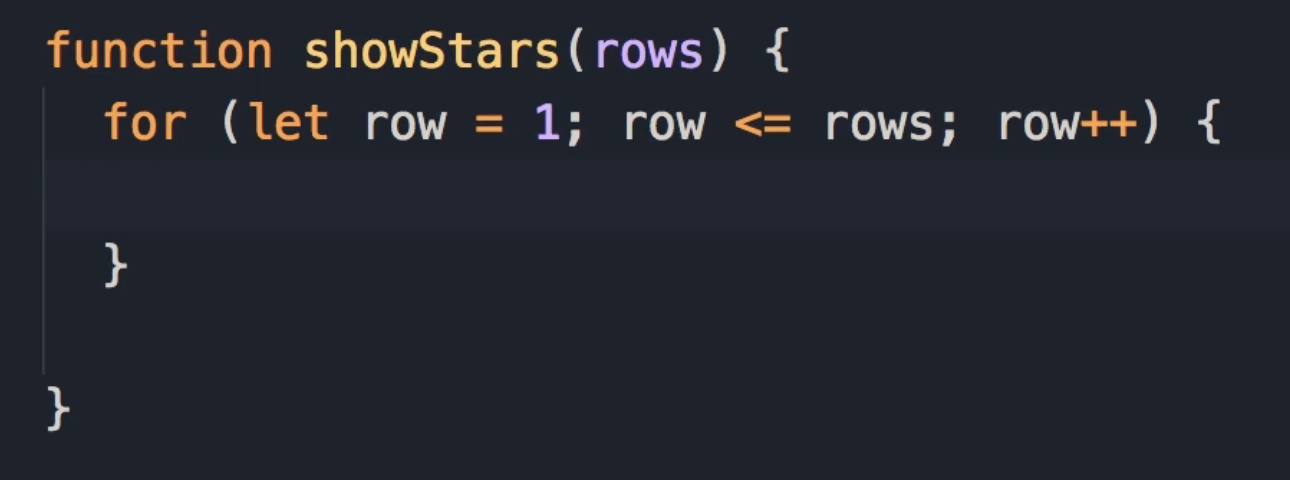
Initialize the Outer Loop
We need to start with a for loop. We set our variable row to 1. As long as row is less than or equal to the number of rows (the parameter), we want to increment row. See the code below:
-
Initialize the Pattern Variable
-
Now, in each row, depending on the number of the row, we need to display one or more stars.
-
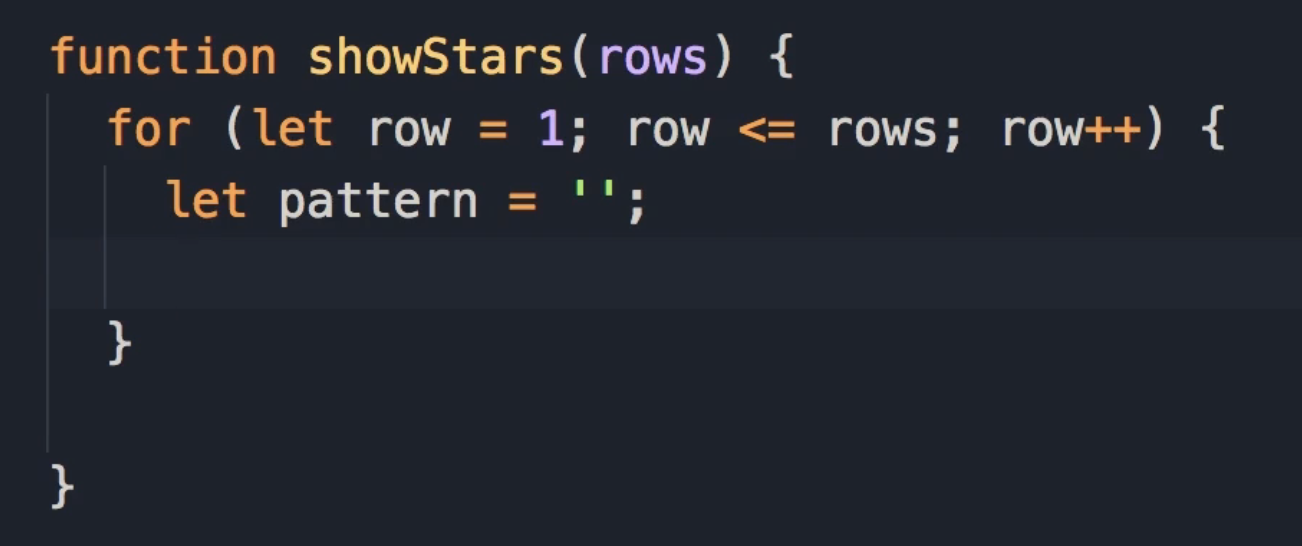
So here, I'm going to declare a variable called pattern and set it to an empty string ('').
-
Now, depending on the value of the row, we need to add one or more stars to this pattern.
-
-
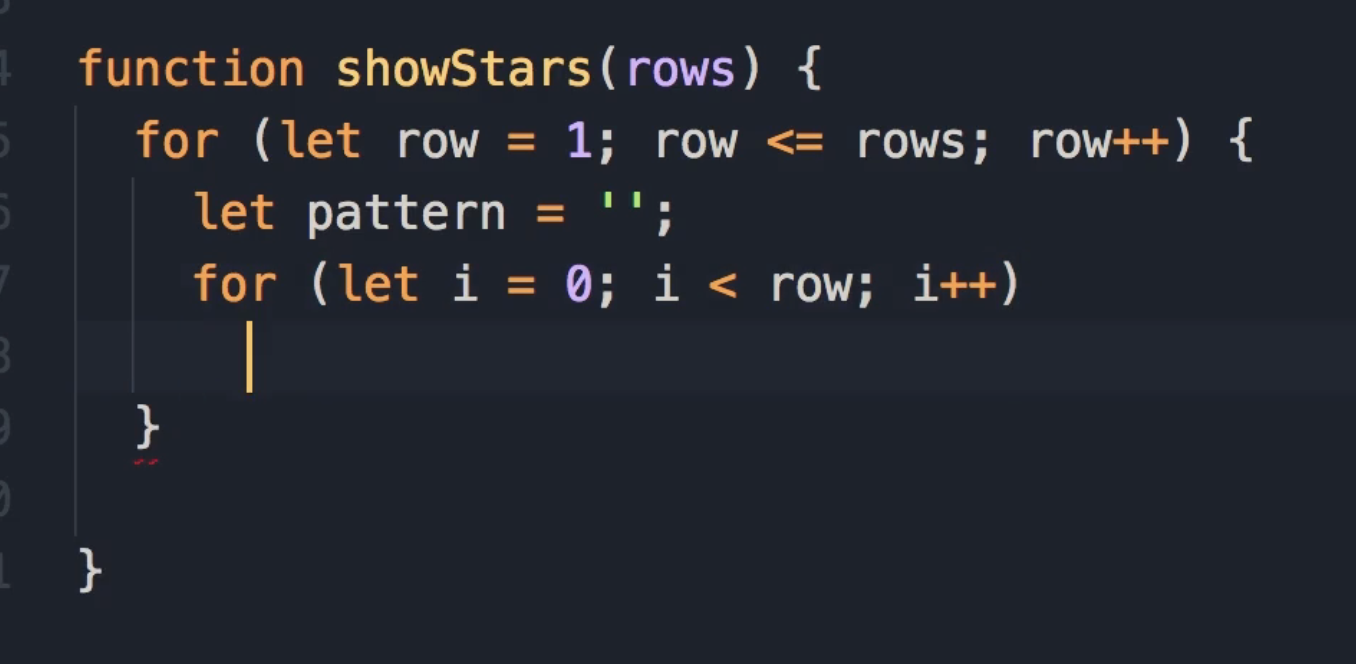
Create the Inner Loop
Here we need another for loop. Let's call the variable i and set it to 0. As long as i is less than row, we increment i.
-
Accumulate Stars
Inside this inner loop, we add a star to the pattern, so pattern += '*'.
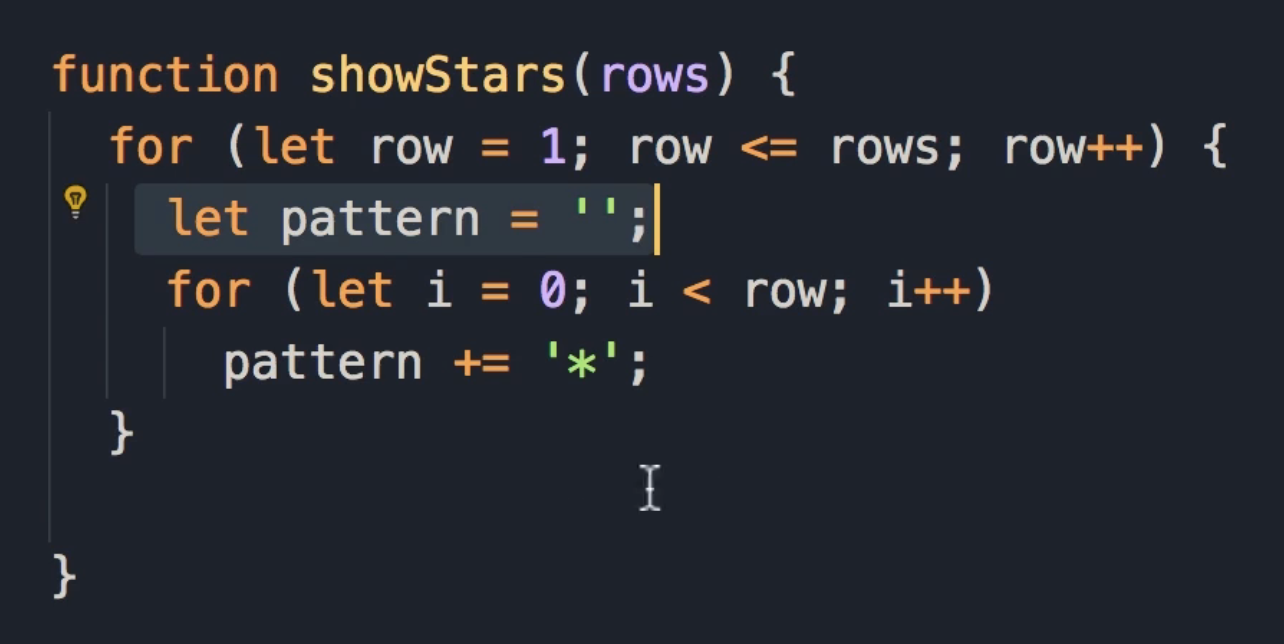
Why this works: If you're on row 5, this loop will execute 5 times because we've started from 0, and we run this while
iis less thanrow. This will execute 5 times, and each time we'll append one star to our empty string. So we'll end up with 5 stars. -
Log the Result
Finally, when we are done with this inner loop, we do a console.log(pattern). That's all we have to do.
Final Code
showStars(5);

function showStars(rows) {
    for (let row = 1; row <= rows; row++) {
        let pattern = '';
        for (let i = 0; i < row; i++)
            pattern += '*';
        console.log(pattern);
    }
}
Testing Methodology
Now, on the top, I'm going to change the input to 5 and save the changes.
*
**
***
****
*****
The algorithm works beautifully.
-
Test Case 1: If you pass 1, we get a single star.
-
Test Case 2: If we pass 2, we get 2 stars (2 rows).
Key Learning: Nested Loops
What we have here is what we call a nested loop. So, we have a loop inside of another loop. You may see this pattern inside a lot of algorithms.